Tag Archives: Adoptees

ROC national day

Taiwan, The Republic of China (ROC), celebrates National Day, otherwise known as Double Ten Day, on October 10th every year. Taipei, Taiwan, is my place of birth. I was adopted as an infant by an American family, and consequently, lost all connection to Taiwan and my first/birth family. That changed, however, over the Lunar New Year of 2012, at which time I traveled to Taipei to reunite with my first family including my two older sisters and brother, my uncle, niece and nephew, and close family friends. Sadly, I know very little about Taiwan’s history and had even less knowledge of Double Ten Day . So I messaged my oldest sister to learn more about its significance. I’m so glad I did, and my sister seemed pleased that I wanted to know more about Taiwan’s history. So I share what I learned now with my fellow Taiwanese adoptees.

Double Day Ten in Mandarin is 雙十節. means double or two; means ten; means day. Here is the history of Double Ten that my sister shared with me:

The Wuchang Uprising in China occurred at the beginning of the Revolution of 1911, and the Qing Dynasty, China’s last imperial dynasty, was overthrown by Chinese revolutionaries. The Republic of China was subsequently established on January 1, 1912. Since the first day of the Wuchang Uprising occurred on October 10, 1911, October 10 is commemorated as the anniversary of the founding of the Republic of China. My sister shared that there is not as much importance attached to Double Ten Day as in years past. She remembers that, at one time, there were many activities on National Day, and the whole country was joyous. The national flag was flown all over the sky, and national flags were placed everywhere on the streets and lanes, fluttering beautifully. There was a flag-raising ceremony at the Presidential Plaza at six o’clock in the morning, and during the day, the heads of state, officials from various ministries, and invited international guests gathered in the stands to watch a military parade. The Air Force and Army presented majestic shows. It was a very popular holiday, and there were numerous performances by various groups celebrating various folk customs. What everyone looked forward to most was the fireworks at night. Colorful fireworks were placed in the square in front of the Presidential Palace, bringing on cheers and applause. Everyone enthusiastically participated in the parade, holding a small flag and walking around for a long time following the performances. My sister said that In recent years, there have been firework displays at Taipei 101 and Sun Yat-sen Memorial Hall. She shared that these are the memories of older generations, and the jubilance once felt as a nation on this day has diminished. Now there are different kinds of activities on Double Ten in Taiwan but it is just a holiday without the same jubilance, and few young people pay attention to its meaning.

I asked about the Double Ten flag and Taiwan’s national flag. My sister explained, our national flag is based on the blue sky with a white sun created by the revolutionary martyr, Lu Haodong, and the founding father, Sun Yat-sen, with red as the background color. The 12 rays of light on the sun represent the 12 months of the year and the 12 traditional Chinese hours in a day (each ray equals two hours). In 1928, the red and blue flag with the white sun officially became the national flag of the Republic of China. The white flag with the double ten red Chinese characters is the flag that represents Double Ten Day.

I appreciate this history lesson about Taiwan from my sister. I hope it has meaning for you, too. There is still so much to learn and know. Incidentally, my daughter’s birthday is on October 10, to which my sister said, she has lucky blessing!

elevate adoptee voices

Since last November, I’ve had the privilege of connecting to many other adult intercountry adoptees around the U.S. via a podcast I hosted called Global Adoptee Talk. Some participated in my podcast and others did not. Nevertheless, just to hear and share stories was incredibly validating, and I appreciate the supportive community that we’re a part of. Unfortunately, I had to let go of my podcast before it even had a real chance to get off the ground due to increasing demands at work and the lack of time and energy I had to keep up with editing/interviewing. I am always inspired, grieved, saddened, angered, and motivated by the many adoptees stories I hear – motivated primarily to elevate adoptee voices in whatever shape or form that may take. It’s always important to be mindful of the fact that though an adoptee may have had a positive adoption experience, there is still undoubtedly loss, trauma, and frequently a longing to connect to cultural roots. That may mean searching for one’s birth parents or first/birth family or traveling to one’s country of origin, learning the language, and/or connecting to others who have similar backgrounds and experiences. It doesn’t go away – it may ebb and flow across the span of an adoptee’s life, but it’s a part of our makeup; it’s part of our DNA and hard-wired into our brains, literally. I don’t have time to go into how separation from birth mother is trauma, but suffice it to say, there is research that supports it. Acknowledging that adoptees have a vital role in the future of how adoption occurs and are given a voice is crucial.

I’m bummed to let go of my podcast, but I have hopes of one day picking it back up, as time allows. I miss that connection to other adoptees. There are plenty of super podcasts out there. Two of my favorite adoptee podcasts are Adoptees On, Adapted, and Born In June Raised in April.    The Rambler was also a favorite, but the show closed earlier this year. All of these podcasts are available on iTunes – listen in – it’s totally worth it.

I sure learned a lot while producing my podcast and am super grateful for those adoptees that I had the opportunity to connect with. Adoptee voices are truly making their way to the forefront of discussions on adoption, as they should. Let us continue to build a strong and vibrant community, inclusive and respectful of all adoptees and their unique stories.

Past episodes of Global Adoptee Talk are available on Soundcloud

a certain slant of adoption

Hello folks! It’s Sunday morning, the skies are gray in my lovely locale. Nevertheless, I’m enjoying the weekend, despite the clouds. It couldn’t have come sooner.

Today, I wanted to talk about adoption…well, duh. I have something more specific in mind. For the past 7 years, I’ve actively searched for and read blogs, books, scholarly research, adoptee group sites, birthmother sites, and adoptive parent sites seeking connection, knowledge, resources, and validation. There are as many views on adoption out there as the colors of the rainbow. As an international and transracial adoptee, my own perspective on adoption has evolved. I don’t think it uncommon for our views to change as we experience personal growth and for lack of a better term, mature. Adoptees have strong inclinations regarding adoption rooted in their own life experiences, and multiple factors shape those attitudes. I’ve spoken with adult adoptees who are not terribly interested in connecting to their cultural roots or birth heritage, nor searching for their birthfamilies. Perhaps there’s a glint of interest, but there is not yet a compelling enough reason or desire to follow it. There are other adoptees who speak strongly against international adoption and for reasons that are quite justified. International adoption has a jaded history, and there are countless adoptees who were adopted illegally, through unethical adoption practices – in some cases both the agency and adoptive parents were plainly aware of the falsification of information. These deplorable practices still occur around the world. There is evidence, and though the U.S. attempts to keep the public aware of these dark practices, they continue.

I have several friends who are adoptive parents and have adopted children internationally from China, India, Africa, Ethiopia, and Russia. They also have very strong opinions and attitudes about international adoption. Sometimes – maybe even frequently – my friends and I do not see eye to eye; nevertheless we remain friends. I strongly believe in family preservation and the support of services to keep children with their biological families. As an adopted person, I cannot see past that. And yet, we live in a world where adoption is still thriving, although in decline internationally. I feel conflicted at times because I have my own very strong attitudes about adoption and yet I am supportive of my friends and other adoptive parents, and that will not change. I am for the welfare of children whether adopted or not.

What I particularly struggle with across the landscape of adoption is judgment and how we judge one another based on our attitudes and opinions towards international adoption. I know that I am judged by others for what I believe and support. I don’t necesarrily like being judged; the word ‘judge’ itself is so harsh. And yet I also judge – it’s inevitable. We all do because it’s human nature. I have no control over what others think and say, but I can temper my own thoughts, words, and actions. I’ve gone through the gamut of emotions related to my own adoption/identity and international adoption in general, from curiosity and awe, to self-loathing and anger, to grief and loss and depression, to acceptance. Like so many adoptees, ignorance makes me angry. It’s complex. There’s a lot of ignorance surrounding international and transracial adoption – adoptive parents experience it, too, and people can say some really dumb things. Sometimes I laugh it off, and other times I get angry and vent to a trusted friend or another adoptee who gets it. There is healing and validation in sharing our experiences.

And what about birthmothers? Of all involved in the adoption ‘triangle,’ their voices and stories are the least heard. And yet, I am certain that they have also experienced trauma, separation, grief and loss, and judgment. We know that women throughout the world have been forced to ‘give up’ their children through coercion for generations (Australia, Brazil, etc). And their children were later adopted by families/individuals from other countries. Societies often judge unwed, single pregnant women who are then stigmatized and left with few options.

What to make of all of this? I will be judged by what I say and do. That’s life, and I can accept that, as painful as it may be. There are a lot of adoptees and other folks out there with some very strong voices and opinions about how things should be. What I won’t accept is bullying by others who believe that everyone should share the same attitude and carry out the same actions. That’s just unacceptable. Adoptees do not all share the same points of view. Similarly, adoptees, adoptive parents, and birthmothers have vastly different experiences. Sometimes what we see on the outside is not what’s on the inside. I realize that we may not always agree, but we can certainly respect one another and our own personal and matchless journeys. We can look for ways to inform others who have not walked in our shoes. I’m speaking as one adoptee to another – I hope to support you wherever you are in life and wherever life takes you. I do believe that collectively, we can make a difference.

a Korean adoptee’s search

Greetings from sunny Long Beach, California! Hope you’re enjoying the holiday season. This morning, I wanted to share a very touching video posted by adoptee, Brent Silkey, who was born in S. Korea and adopted by an American family. Brent is currently searching for his birth mother. I saw the video below posted on an adoptee-only Facebook group page, Adoptees from Asia, and knew I had to post it here. The video has received around 136,000 views worldwide so far and close to 3,500 shares.

Brent’s birth mom and dad met through mutual friends and started dating. They enjoyed things like camping together with their friends. After their relationship ended, Brent’s birth mom found out she was pregnant. She had no way of getting in contact with his birth father. She came from a family that didn’t have a lot of financial means and dropped out of school after her second year of middle school (the US equivalent of 8th grade). Brent believes his birth mom helped her family cleaning homes, and she was the eldest of three girls. She lived with her father and father’s parents.

When Brent was born, his birth mom was just a teenager (19 years old in Korea, which is equivalent to 18 in America). He was a full-term baby and was placed for adoption immediately.

Brent expressed: I don’t know exactly why, but I would imagine that she wanted to give me the gift of life, but knew she would have been unable to take care of me with the other demands of her life and family.

I am SO thankful for her. I love her. I want to tell her how thankful I am for giving me the opportunity to be taken care of by such a wonderful foster family and then to be adopted by my parents in America. I have had such a blessed life and I want to give my birth mom a hug and thank her for being courageous enough to have me and to give me a great opportunity to have a wonderful life.

It is my dream to meet her in person, to share with her my life’s journey, and to tell her how my life has been forever changed by the love of God through Jesus Christ.

I would be incredibly honored to introduce her to my beautiful wife and two daughters (her granddaughters!!). We would do whatever we needed to in order to have the opportunity to meet her and to have relationship with her if she would allow us to.

I have only feelings of love, respect, and gratitude toward her.

I hope she has not carried around a sense of guilt or shame for the last 30 years. That is why I want to give her a hug.

I’ve been working with my adoption agency, but we continue to hit road blocks regarding the search. Her name is a very common name and “they don’t have the man power” to search for her.

I hope you’ll join me in supporting Brent and passing this video along. I’m certain that his birth mom never forgot him.

out of the fog

A recent post written by another adoptee caught my attention the other day. The author’s name is Kumar, and he blogs at A Stroll Through My Mind. Kumar was adopted from Pudukottai, Tamil Nadu, India. In this particular post, he discusses a book, Daughter of the Ganges, written by author/adoptee, Asha Miro. Miro chronicles her travels back to India to uncover her native roots. She visits India on two separate occasions, the second eight years after the first. What struck me as I read Kumar’s post was his comparison of the two trips and how the impetus of Miro’s journey seems to change over time. He reflects, “Her first [trip] feels naive, innocent and very good natured. She, as I would do myself, trusts that others have her best interest at heart and ends up receiving information that is not wholly accurate.” I have not read Miro’s books, but could certainly relate to the naivety in which Miro sets out to uncover her roots and the receipt of inaccurate information. Kumar shares that he similarly trusted that others had his best interest at heart, as did I when I first began this blog and the initial search for my birthfamily in Taiwan. I trusted my adoptive parents and the information they provided to me only to find out that the information was hugely inaccurate. Unfortunately, I will probably never know where the lines got crossed. Miro’s second journey to India is quite different. Kumar says, “She pushes people for information, gets the necessary help and is able to create some amazing connections.” Adoptees are constantly pushing others for information. It often doesn’t come easily.

I set out to find my own native roots anxious to investigate the unknowns and find answers. I had a right to know about my past, yet my adoptive parents failed to provide this to me. Finding and reunifying with my birthfamily has been one of the most significant events in my life, one that I continue to ponder. That my sisters and family never forgot me and wanted to reunite is beyond wonder. As I have researched international adoption and read the stories of many other adoptees and birth mothers, I have lost the naivety I once possessed regarding adoption. Although I gather that many adoptive parents approach international adoption with the best of intentions and for a multitude of reasons, the very nature of international adoption is complex and rooted in loss, which is oft misunderstood or minimized. The loss of a culture and language, the loss of parents/caregivers, the loss of everything familiar is no small thing, and this grief and loss cannot be understated nor underestimated. Most internationally adopted children eventually adapt and assimilate, yet for some of us, the unknowns continue to be painful reminders that our pasts are not quite whole.

I know that my adoptive parents loved me, and despite the challenges in our family, I loved my parents. It was not easy growing up in my adoptive family, and I was often conflicted by their expectations and anger, primarily my adoptive mother’s, and my own insecurities. I’ve come to terms with who I am as a transracially adopted person, although there are days when my drive for perfection and neurosis drives even me crazy. I’m no longer the naive, “good natured” adoptee that I once was, which is actually freeing. I can’t help but be a little cynical and sarcastic. With age and maturity, I’ve come to a new knowledge, perspective, and understanding – in other words, like many other adult adoptees, I’ve come “out of the fog.”

I have many friends who have adopted children internationally, and it’s ironic that I somehow end up inadvertently in the company of others connected to adoption in some way…One of the psychiatrists I worked with at the state hospital had children adopted from Ethiopia and I want to say Guatemala, and my co-worker, also a social worker, was adopted from Brazil. On the long plane ride to the adoption initiative conference in NJ, I happened to sit next to a woman who had an adopted daughter from China. She wanted to know about my experiences and how I managed. Her daughter is a second year college student going through her own set of challenges. Go figure.

I find it difficult to discuss international adoption as the only alternative. I know far too many adoptees around the world whose stories are not characterized by the “forever family” rhetoric and whose adoptions occurred as a result of unethical adoption practices (that’s another story). Search and reunion becomes extremely difficult as you can well imagine because of falsified information or lack of information. But no matter, adoptees are resilient. I think it’s in our genes. We awaken, we learn, we evolve, we transform, and we become. Sometimes it’s a lonely, misunderstood road, but we keep going…And we wish our voices to be heard by those in the industry who would otherwise hope for us to be grateful that we were adopted.

annoying stereotypes & microaggressions

I enjoy meeting and talking with other international and transracial adoptees. That we are adopted persons gives us a social identity that is unique. The environmental contexts in which we grow up are doubtless very different, and our adoption journeys are unique; however, when I talk to other internationally adopted persons, there’s a connection. It’s like, he or she gets me. We get each other.

Towards the end of my last semester of grad school, I learned that the student who sat right across from me in my Advanced Practice class was also an adoptee. She was adopted from Korea and grew up in Michigan. She is some twenty years younger, yet I immediately felt that kinship with her. We met for coffee one afternoon after class to commiserate over school and swapped stories about adoption. We laughed about stereotyping and how we have managed to live in a predominantly white world. It felt good to connect with another adoptee who also happens to be a social worker!

Earlier this month, I met with another adoptee, a friend. She, too, was adopted from Korea. We met for lunch at a Vietnamese sandwich shop to catch up. During our conversation, she asked me about my feelings towards international adoption after having completed my thesis and if I had an interest in working in international adoption. It is such a difficult question to answer, and I don’t think that I have a definitive one. We talked about our conflicted feelings towards international adoption. On the one hand, orphans need permanency and loving families. On the other hand, the complexities of international adoption are significant, and there is a great need for others to be educated. There is still so much to learn about international adoption, how it impacts the psychosocial development of adoptees, and how to help prepare and support adoptive parents, as well as adoptees – not that any parent regardless of adoptive status or not could ever be fully prepared for parenthood. But there are ways to better educate the general public and adoptive families and to offer a more realistic picture of this process.

My journey through adoption continues to evolve. Although I have experienced incredible personal growth through the years, I’m not sure that I could work in international adoption, at least not in the capacity of a caseworker. I’m sure that my own personal challenges as an adoptee have much to do with these conflicted feelings. I can help educate adoptive families, provide cultural training and support, try to impact international adoption policy, but don’t think I could manage the actual adoption process. I have several friends who have adopted children internationally, and I always think in the back of my mind that international adoption is a business. I would support greater efforts to prevent the need for adoption altogether…preventive services and services to keep families together.

While we were sitting and conversing, an older white gentleman walked over to us and interrupted our conversation to ask if either of us knew of a good Asian salon where he could get his hair cut. He told us that most of the Asian women he encounters don’t speak very good English and upon hearing our conversation and ability to speak “good” English, felt like we could point him in the right direction. I felt completely annoyed. I told the man that I did not know of any Asian salons as did my friend. The look on his face was one of complete shock. It told me that he assumed we knew the right salon to direct him to. We did not tell the man that we were both adopted and knew as much about Asian salons as the man in the moon. Instead, we watched him walk away, perplexed, and returned to our conversation. I could not shake off how ruffled I felt. Although this man was completely unaware, he had committed a microaggression that was just plain annoying.

I’m glad to have visited with my friend. It was encouraging to hang out with another adoptee, someone who has walked in “my shoes” in many ways. I didn’t ask her if she felt as annoyed as I did by the man who asked us about a hair salon. She seemed to brush it off and was so polite. I took her lead and decided to be polite, too, despite my feelings.

international adoptee research study

In my last post, I mentioned that adoptees in the U.S. adopted through international adoption are often subjected to racism, discrimination, and microaggressions. It’s a subject that interests me greatly because I know how damaging the effects of racism, discrimination, and microaggressions are. I chose to investigate this subject for my master’s thesis in social work.

Over the past two months, I’ve sent letters and announcements to numerous adoption agencies, primarily in Arizona, but also California and Oregon. I have contacted adult adoptee groups on social media platforms and reached out to friends who may know of families with adopted children. I continue to search for adoptees 18+ years of age who were adopted from another country to the U.S. by parents of a different race/ethnicity to participate in the study. Participation includes an in-person interview. In the interview, I talk with adoptees about their background, experiences with family, peers, and their community. We discuss incidents that the adoptee has experienced related to racism, racial discrimination, microaggressions, prejudice, and stereotyping. My hope is to interview at least ten adoptees for this qualitative study. So far, I’ve conducted five interviews. The interviews are about 1.5-2 hours in length and are conducted in a location that ensures privacy, i.e, a study room at a local library. I use participatory diagramming or visual timelines to examine critical points in each adoptee’s life related to racism, discrimination, microaggressions, prejudice, and/or stereotyping as part of the interview process. Participants are informed that the interviews are confidential and no identifying information will be revealed in the study.

How international and transracial adoptees personally cope with racism and discrimination is not an area that is well understood in the literature. It is hoped that this research will produce data that will inform the development of interventions for international adoptees and their families that will provide tools to manage the effects of racism and discrimination. I hope that the study will also prompt further investigation into this particular area. If you know of an adoptee or are an adoptee who resides in Arizona and might be interested in participating in this study, please pass along the above information. I can be contacted privately at mcnguyen@asu.edu if you’d like to know more about the study or would like to schedule an interview. Any help you can provide would be greatly appreciated!

I believe that this is such an important issue for adoptive families and adoptees. It’s my belief that adoptive families and adoptees who are better equipped to face racism and discrimination will be happier and healthier. Thank you.


international adoptees needed for research study

Hello everyone! I hope that you are staying cool during these hot summer days. We have officially hit triple digit weather here in Arizona! I have written recently that I’m working on a master’s thesis. I’m currently looking for volunteers to participate in this qualitative research study.

The purpose of the study is to examine the ways in which international and transracial adoptees experience racism, prejudice, racial discrimination and/or stereotyping and to identify patterns of coping. To explore these issues, interviews with international adoptees will be conducted. Results from the study will highlight the unique experiences of internationally adopted persons and provide a deeper understanding of how adoptees cope with racial derogation and discrimination. In-person interviews with adoptees will be approximately 1.5-2 hours.

To participate in this study, individuals should:

  • Be at least 18 years of age or older
  • Be adopted from another country to the U.S. by parents of a different race/ethnicity
  • Currently reside in Metro Phoenix, Arizona

All interviews will be conducted in a location that ensures privacy and confidentiality.

By participating in this study you will be contributing to the work of understanding how international and transracial adoptees manage racism and discrimination in their lives and how these issues impact the development of adoptees’ identity. The study will help to inform social workers and other healthcare professionals what types of support services would most benefit international and transracial adoptees and their families.

If you are interested in participating or would like more information about the study, please contact me. The link below contains a formal announcement including my contact information. Please feel free to distribute the announcement to any persons you think might have an interest in participating in the study. Thank you!

This research is conducted under the direction of:

Cecilia Ayón, MSW, PhD

Associate Professor

School of Social Work

College of Public Programs

Arizona State University

Click on the link below for the announcement and my contact information:

Study_Announcement_2014

our screening event

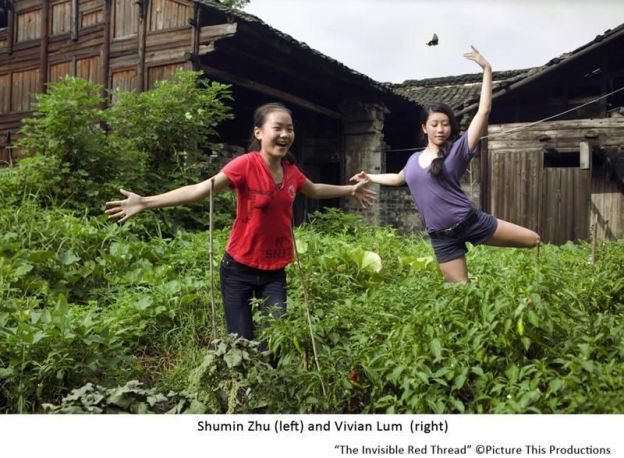
The Invisible Red Thread made me laugh, made me cry, made me more attuned to the disturbing fact that orphaned and abandoned children in this world are far too numerous. On Saturday, June 1st, we screened the film documentary at an event called Honoring One’s Cultural Roots. Twenty-two people attended, including adoptive parents and their adopted children. There were seven adoptees, three were adults.

The documentary was filmed in 2010 by directors Maureen Marovitch and Dr. Changfu Chang and follows two adopted adolescent girls from China who live on opposite sides of the planet. We accompany 15-year old Vivian, who lives with her family in Toronto, Canada, as she and her adoptive father, Hubert, travel back to China to meet Shumin. Shumin, 14 years old at the time of filming, was adopted within China by the Zhu family due to the One Child Policy. Unfortunately, Vivian’s adoptive mother was unable to travel to China with her and her father due to a sudden illness.

The film was about an hour long. I laughed when Shumin introduced Vivian to shopping outdoor market style where many interesting and live foods were being sold, including frogs, snakes, and all kinds of seafood. We watched Vivian squirm as she walked with Shumin up and down the aisles of the market holding her nose. On the flip side, Vivian took Shumin and her family to the city, which Shumin had never visited before. Shumin used a fork and ate toast and jelly for the first time. Watching Shumin’s facial expressions as Vivian showed her how a toaster worked was priceless. Vivian pondered what life would have been like for her in China had she not been adopted.

We also met Shumin’s birth parents, as well as another birth mother who was searching for the daughter she gave away in hopes that Vivian might be her daughter. This adoptive mother was obviously feeling so many emotions as the filmmakers documented her story. Vivian was not her daughter. Without fail, whenever I see the pain a birth parent feels due to the relinquishment of his/her child, I’m deeply saddened.

After the film, therapist, Stephanie Withrow, facilitated a discussion with those who were able to stay. One of the highlights of the discussion was how international adoption has evolved since it first became “popular” in the U.S. after the Korean War. One parent pointed out that because much has been learned about international/transracial adoption over the years, adoptive parents are more informed and educated about the challenges of raising an internationally and transracially adopted child. It’s possible that adoptees today may even experience fewer problems with identity and race because adoptive parents are more sensitive to these issues, facilitate an open dialogue with their adopted children, and seek opportunities to help their child develop a healthy sense of identity. I think more research is needed to demonstrate how changes in international adoption over the past few decades may affect adoptees and their families compared to previous decades. Finally, Dalena Watson prepared some information on homeland tour agencies for families interested in perhaps planning a trip one day to their adopted child’s birth country.

As a final note, I wanted to again thank all those who came out and spent the afternoon with us. It was a pleasure to meet all of you and your families. Your thoughts and comments are invaluable, and we hope to continue hosting community adoption events that you’ll be interested in attending.