she looks to the sky for some divination, some explanation for the way things are why did the stars align as they did on the day she was born? why was she vanquished to a place where she languished until it was decided she’d grow up foreign? daydreams and portals, she was anything but normal drawn to the celestial, a bit of a rebel a Starseed is she when things get too troubling on Earth, she is struggling she remembers how silly of her to forget that she is the love of her life she will survive she will yet thrive, and that is all that she needs
For my fellow adoptees who know too well the hurts caused by adoption…
Berceuse in D-Flat, Op. 57, Frédéric Chopin. I love this piece so much and have always wanted to learn to play it. Chopin was always so difficult to play for lots of different reasons. I have small hands, and in Chopin’s piano literature, there are often large intervals that I had to get creative playing, not to mention the technical difficulty. I was an average pianist in my abilities compared to my peers and wasn’t super diligent with practice. I mean, 8 hours a day of practice was just not me. Four was about all I could mange. If super inspired, maybe six, lol. I learned one of Chopin’s Ballades (A-Flat) in my undergraduate piano studies. It was such a beautiful piece – I remember wishing that I could perform it better. I also recall another more technically advanced individual telling me it was Chopin’s easiest Ballade. I just wanted to say, fuck off. I truly hated the perfection required in classical training. Always riddled by performance anxiety. Probably why I despised performing and liked dancing and acting better – you could improvise if you messed up. I do admire pianists who achieve that level of performing. I think I’d be a different performer now, however.
Anyway, one of my professors performed the piece during a recital, and it was such a lovely performance. Was mesmerized. I like Gorlatch’s performance, as it’s at a tempo I prefer for this piece. He makes it look so easy! In fact, this piece is really difficult. So much is subjective within the limits of the period and style the piece was written in. It’s interesting to compare pianists’ interpretations. There is a performance I enjoy slightly more, Wibe Soerjadi, but couldn’t find on YouTube. I love alternative/indie/classic rock and other genres, but often go back to classical when I need to get more grounded.
May is winding down, and boy has it been a busy month. May is officially recognized as Asian Pacific American Heritage Month. Celebrations occur throughout California during the month including the Los Angeles Asian Pacific Film Festival and the Taiwanese American Cultural Festival, which is held annually in the Bay area. TACF is sponsored by Taiwanese American Professionals-San Francisco and Taiwanese American Foundation-No. California. This year, TACF featured a collection of nearly 50 works by authors, writers, poets, and creatives who are Taiwanese American or have ties to Taiwan, and guess what? My book, Beyond Two Worlds: A Taiwanese-American Adoptee’s Memoir & Search for Identity was one of the works featured! For the entire list of books showcased and brief descriptions of each book, visit Taiwaneseamerican.org.
Thank you, Ho Chie Tsai, for gathering this wonderful collection of books highlighting Taiwanese American storytellers. I wish that I could have attended the festival and seen the display in person as well as all of the other festivities. I’ve put several of the books on my to-read list.
If you’d like to purchase an autographed copy of my book, just follow this link.
Here are some photographs from the Taiwanese American Cultural Festival 2018!
Since last November, I’ve had the privilege of connecting to many other adult intercountry adoptees around the U.S. via a podcast I hosted called Global Adoptee Talk. Some participated in my podcast and others did not. Nevertheless, just to hear and share stories was incredibly validating, and I appreciate the supportive community that we’re a part of. Unfortunately, I had to let go of my podcast before it even had a real chance to get off the ground due to increasing demands at work and the lack of time and energy I had to keep up with editing/interviewing. I am always inspired, grieved, saddened, angered, and motivated by the many adoptees stories I hear – motivated primarily to elevate adoptee voices in whatever shape or form that may take. It’s always important to be mindful of the fact that though an adoptee may have had a positive adoption experience, there is still undoubtedly loss, trauma, and frequently a longing to connect to cultural roots. That may mean searching for one’s birth parents or first/birth family or traveling to one’s country of origin, learning the language, and/or connecting to others who have similar backgrounds and experiences. It doesn’t go away – it may ebb and flow across the span of an adoptee’s life, but it’s a part of our makeup; it’s part of our DNA and hard-wired into our brains, literally. I don’t have time to go into how separation from birth mother is trauma, but suffice it to say, there is research that supports it. Acknowledging that adoptees have a vital role in the future of how adoption occurs and are given a voice is crucial.
I’m bummed to let go of my podcast, but I have hopes of one day picking it back up, as time allows. I miss that connection to other adoptees. There are plenty of super podcasts out there. Two of my favorite adoptee podcasts are Adoptees On,Adapted, and Born In June Raised in April. The Rambler was also a favorite, but the show closed earlier this year. All of these podcasts are available on iTunes – listen in – it’s totally worth it.
I sure learned a lot while producing my podcast and am super grateful for those adoptees that I had the opportunity to connect with. Adoptee voices are truly making their way to the forefront of discussions on adoption, as they should. Let us continue to build a strong and vibrant community, inclusive and respectful of all adoptees and their unique stories.
Past episodes of Global Adoptee Talk are available on Soundcloud
Mrs. Guinn placed the clunky brown headphones snuggly over my head, the giant earpieces squeezed my temples. A long, coiled cord snaked across the shaggy green carpet to a stereo where she stood, ready to drop the needle. I had no idea what I was in for. Mrs. Guinn had never offered to play music for me at any of my other piano lessons. Mandi, my friend next door, and I took weekly lessons at Mrs. Guinn’s home. I loved going to Mrs. Guinn’s for my piano lessons and looked forward to them every week. She lived in a quiet neighborhood in Shady Grove and was a white, 30-something year old woman. She had short brown hair in a long pixie style, a pretty face, and was always dressed in jeans and a nice top. Mrs. Guinn was married to an officer in the Air Force. I remember her as having a quiet and gentle demeanor. She reminded me of Toni Tennille of Captain and Tenille. The front living room where Mrs. Guinn taught had an upright piano on one wall and an organ against another, a large window overlooked the street. Her house was always meticulously clean and smelled good. “I have something I want you to listen to today,” she said as she guided me into the den. The headphones felt heavy against my ears as she adjusted them. I sat silently and settled into Mrs. Guinn’s plush black couch, waiting for the music to begin playing.
“Da-da-da-DUM.” “Da-da-da-DUM!” Those first four notes of Beethoven’s all too famous Fifth Symphony bellowed in my ears. The music accelerated, and I was completely enraptured, magically swept away. The pulse of the bass vibrated in my chest. I was only 9-years old at the time, and yet that was such a defining moment in my life. The rest of the world fell away in those brief eight minutes or so of that first movement. I was an extremely shy, introverted kid, but at my lesson the following week, I mustered the courage to ask Mrs. Guinn if I could listen to that recording again. Of course, she obliged. Little did Mrs. Guinn know how much that recording influenced me. I discovered I had a love for classical music. One of the other things I enjoyed while taking lessons from Mrs. Guin was the monthly gatherings she held at her home where all her students performed. The best part was when she performed for us on her organ. I loved watching her feet fly across the pedals. It was certainly a treat.
Mrs. Guinn was a member of the National Federation of Music and entered me into my first music festival where students performed and were adjudicated. I received a superior + and was selected to perform in the Honors Recital with many other students. Kabelevsky’s, The Clown, Op. 39, No. 2, was my first performance piece ever. As I climbed the stairs the night of the recital towards the concert grand piano, it felt as though I were having an out of body experience. Somehow, I got through my piece without any fumbles and took my bow to the applause of the audience. I would perform in many other recitals, each one causing more anxiety than the last. It was something I continuously struggled with.
Mrs. Guinn moved within a year or two. I was deeply saddened when she told me her husband had received a military transfer to Texas, as I had become quite attached to her. It was very hard to say goodbye, and I remember having a hard time sleeping the night before my last lesson. I probably shed a few tears, too.
My mom found a new teacher, and I began taking lessons from Mrs. Ellis, whom I didn’t like very much. The music she gave me to play was “old” and not very fun. Mrs. Ellis was older than Mrs. Guinn and had short, reddish hair and a southern drawl. I didn’t feel the same connection with her as I had with Mrs. Guinn and dreaded going to my lessons where very often, her daughter, about my age, invited me to play while I waited for the kid’s lesson before me to end. She had what seemed like a million trophies from beauty pageants stacked in her room, and I remember jumping on the trampoline with her in the backyard. I felt awkward next to her, as she seemed so accomplished for a kid our age. Eventually, I moved on and studied with Mr. Robert Buckner during my high school years. Mr. Buckner lived in Shreveport and was quite a colorful character. He had a piano studio behind his house and a dachshund named Angie. Mr. Buckner’s gray hair was always disheveled and seemed to stand on end to one side. I began every lesson with major and minor scales to warm-up, or Hanon exercises. I felt comfortable with his teaching style and sense of humor. Mr. Buckner was bit of a stout man with a laugh that welled up from his belly, which was quite infectious. A couple of times, I caught Mr. Buckner sleeping while I played. His snores always gave him away.
I decided to major in music and attended Centenary College of Louisiana where I studied piano performance, primarily because it meant I didn’t have to take a single, damn math class. I was beyond horrible in math or anything that had to do with numbers. Initially, I felt terribly inadequate compared to my peers who seemed to have much better training musically than I did. I struggled with ear training and theory and loathed sight singing, but loved composition and piano literature. It wasn’t that I couldn’t sing, it’s just that I had never been taught sight singing, and it terrified me, especially when made to sight sing in front of all my peers. That was a very joyless experience. I studied with Constance Knox Carroll and absolutely adored her. She was an inspiring teacher and incredible pianist. I’m sure, however, that I was one of her least favorite students, as I was not very disciplined and did not practice as I should have, especially during my senior year when it was expected to perform a solo recital of full repertoire. I got distracted with theatre and dance and remember her scolding me at one particular lesson for my lack of practice. I hadn’t memorized all of my pieces, and my recital loomed near. I just sat there unable to say a thing. No doubt, part of her concern was that a poor performance would reflect badly on her. She said that it seemed like I liked theatre and dance better. She was right. What did I know at that age? Not a whole lot, except there was much less pressure when you were having fun, for God’s sake.
I wasn’t exactly lazy, but discipline was not my strong suit. Practicing was such an isolating, arduous endeavor, and yet in those days, I didn’t always mind it. I typically hit the practice room four hours a day, sometimes six on the rare occasion that I was super inspired. There were times when it was such a rewarding experience to sit at the keyboard and just play without anyone listening. The freedom from judgment or making mistakes, the connection to the music; it was magical. Those were the times when I performed the best. But in front of an audience, I lost all sense of composure. Performance anxiety plagued me. I could not control my hands; they became leaden. Adrenaline rendered me helpless, and memory slips haunted me. On one occasion, several students were to perform with the Shreveport Symphony in a special recital. I was performing the first movement of Mozart’s Piano Concerto in A, K414. I can’t describe how exhilarating it was to perform with a live orchestra. Connection to other musicians performing together was something I had never experienced. It was like flying, but without the motion sickness. Unfortunately, performance anxiety got the best of me, and my memory lapsed somewhere during the development. The orchestra continued to play as if nothing happened while I sat frozen, paralyzed. Eventually, I wove my way back in, but the damage had been done. I barely made it through the cadenza. Instead of enjoying such a performance, I was relieved when it was over. My legs were so shaky afterwards, I could barely stand.
After graduating college, I taught piano for a brief time at St. Mark’s Episcopal in Shreveport and another Christian school before moving to Florida. I didn’t touch a keyboard for nearly 20 years after that. The trauma of it all prevented me. I deeply regret that now. One day, my mom asked if I wanted my baby grand piano, the one they bought me when I first started taking lessons. Of course I did, and a couple of months later, my baby grand arrived at our tiny condo in California. It took up an entire room. I started teaching piano thereafter at a Christian elementary school in Mission Viejo, CA, and eventually taught privately on and off until 2013. My piano skills were sadly more than a little rusty, and I lamented the loss. I attempted to take piano lessons a couple of different times, but just didn’t have the time to commit to practicing with family responsibilities and work. I stopped teaching altogether in 2013 when I went back to school to pursue a Master’s degree in Social Work.
I have now had my baby grand since 1999. It has moved with us many different times in the last several years. It’s sitting in our family room in need of a little TLC – or a lot actually. When we returned to California in 2016, my husband tried to talk me into selling it because all the homes in California are so much smaller! It was more challenging to find an “affordable” (there are no affordable homes in California) home that would accommodate its size. First of all, I silently fumed that he’d ask such a thing that’s so important to me, and second I refused to budge. We were not going to sell my baby grand piano! And so it was and is and will ever be.
Every once in awhile, I sit down to play when things are quiet and I can get away with it. Recently, I felt moved to find Mrs. Guinn and searched for her via Google. Amazingly, I found her, and she wrote back to me immediately. She continues to teach, perform at churches, and accompany choirs in Nebraska. Although she only vaguely remembered me, she said that she looked up old recital programs and located one dated May 23, 1976, that I performed in. She said I played a Schaum arrangement of Yankee Doodle as a solo and again in a trio performance with Mandi, my friend, and another student named Kelly Scott. I was so happy to hear from Mrs. Guinn and that she continues to teach and play.
I trained in piano for many, many years. I wish that I’d continued to play, but there was a part of me that felt my skills were inadequate, so I didn’t play for years. When I decided to study music therapy in 2006, that passion for music rushed back. And now, I long for my piano to be more than just a pretty conversation piece in my living room. One of these days, and hopefully not too long from now, I will get back to playing, perhaps a little at a time. Sometimes, it’s hard to play because I inevitably begin to compare my current level of skill to that of when I played daily for very long hours. People tend to tell me, “you should just play for yourself.” Well, it’s easier said than done. Nevertheless, music is truly part of my fabric. I can’t think of anything more powerful and transformative than music.
So, for your listening pleasure, here is one of my favorite pianists, Murrah Perahia, at the keyboard performing Mozart’s Piano Concerto No. 12 in A, K. 414. It always makes me happy to listen to this beautiful piece of music.
To Mrs. Carroll, who inspired me to be a better pianist:
Beyond Two Worlds: A Taiwanese-American Adoptee’s Memoir & Search for Identity is now live! If you have not yet purchased your copy, don’t delay. I have a few books left, and signed copies can be purchased right here on my website. Just click on Shop to order. Kindle and hardcover editions are available via my author page at Amazon, and you can also find the book at Barnes & Noble, and Indiebound.org.
If you enjoyed reading the book, please consider leaving a review on Amazon, or wherever you purchased your copy. Unfortunately, I am unable to ship internationally; however, those copies can be ordered through Amazon and Barnes & Noble online. To learn more about the book and to read an excerpt, click here, and to read reviews, click here. Thank you for supporting Beyond Two Worlds.
Hello folks! It’s Sunday morning, the skies are gray in my lovely locale. Nevertheless, I’m enjoying the weekend, despite the clouds. It couldn’t have come sooner.
Today, I wanted to talk about adoption…well, duh. I have something more specific in mind. For the past 7 years, I’ve actively searched for and read blogs, books, scholarly research, adoptee group sites, birthmother sites, and adoptive parent sites seeking connection, knowledge, resources, and validation. There are as many views on adoption out there as the colors of the rainbow. As an international and transracial adoptee, my own perspective on adoption has evolved. I don’t think it uncommon for our views to change as we experience personal growth and for lack of a better term, mature. Adoptees have strong inclinations regarding adoption rooted in their own life experiences, and multiple factors shape those attitudes. I’ve spoken with adult adoptees who are not terribly interested in connecting to their cultural roots or birth heritage, nor searching for their birthfamilies. Perhaps there’s a glint of interest, but there is not yet a compelling enough reason or desire to follow it. There are other adoptees who speak strongly against international adoption and for reasons that are quite justified. International adoption has a jaded history, and there are countless adoptees who were adopted illegally, through unethical adoption practices – in some cases both the agency and adoptive parents were plainly aware of the falsification of information. These deplorable practices still occur around the world. There is evidence, and though the U.S. attempts to keep the public aware of these dark practices, they continue.
I have several friends who are adoptive parents and have adopted children internationally from China, India, Africa, Ethiopia, and Russia. They also have very strong opinions and attitudes about international adoption. Sometimes – maybe even frequently – my friends and I do not see eye to eye; nevertheless we remain friends. I strongly believe in family preservation and the support of services to keep children with their biological families. As an adopted person, I cannot see past that. And yet, we live in a world where adoption is still thriving, although in decline internationally. I feel conflicted at times because I have my own very strong attitudes about adoption and yet I am supportive of my friends and other adoptive parents, and that will not change. I am for the welfare of children whether adopted or not.
What I particularly struggle with across the landscape of adoption is judgment and how we judge one another based on our attitudes and opinions towards international adoption. I know that I am judged by others for what I believe and support. I don’t necesarrily like being judged; the word ‘judge’ itself is so harsh. And yet I also judge – it’s inevitable. We all do because it’s human nature. I have no control over what others think and say, but I can temper my own thoughts, words, and actions. I’ve gone through the gamut of emotions related to my own adoption/identity and international adoption in general, from curiosity and awe, to self-loathing and anger, to grief and loss and depression, to acceptance. Like so many adoptees, ignorance makes me angry. It’s complex. There’s a lot of ignorance surrounding international and transracial adoption – adoptive parents experience it, too, and people can say some really dumb things. Sometimes I laugh it off, and other times I get angry and vent to a trusted friend or another adoptee who gets it. There is healing and validation in sharing our experiences.
And what about birthmothers? Of all involved in the adoption ‘triangle,’ their voices and stories are the least heard. And yet, I am certain that they have also experienced trauma, separation, grief and loss, and judgment. We know that women throughout the world have been forced to ‘give up’ their children through coercion for generations (Australia, Brazil, etc). And their children were later adopted by families/individuals from other countries. Societies often judge unwed, single pregnant women who are then stigmatized and left with few options.
What to make of all of this? I will be judged by what I say and do. That’s life, and I can accept that, as painful as it may be. There are a lot of adoptees and other folks out there with some very strong voices and opinions about how things should be. What I won’t accept is bullying by others who believe that everyone should share the same attitude and carry out the same actions. That’s just unacceptable. Adoptees do not all share the same points of view. Similarly, adoptees, adoptive parents, and birthmothers have vastly different experiences. Sometimes what we see on the outside is not what’s on the inside. I realize that we may not always agree, but we can certainly respect one another and our own personal and matchless journeys. We can look for ways to inform others who have not walked in our shoes. I’m speaking as one adoptee to another – I hope to support you wherever you are in life and wherever life takes you. I do believe that collectively, we can make a difference.
Hello out there! I’m very happy to announce that you can now pre-order your copy of my new book, Beyond Two Worlds: A Taiwanese-American Adoptee’s Memoir & Search for Identity. Please spread the word and encourage your friends and family to purchase their book on the Beyond Two Worldswebsite. Just click on the “Shop” tab above, which will direct you to PayPal. All books purchased through my website will be signed and autographed.
About the Book:
Born in Taipei, Taiwan, Marijane was adopted by an American military family at four months old. She grew up in a middle class neighborhood where hers was the only Asian face amongst a majority of white.
Raised to believe she was Vietnamese and Japanese, she never doubted what her adoptive parents told her, until one day, she found her lost adoption papers. This discovery unloosed secrets that had been buried for decades, causing her to question her own identity and origins. With brave determination, Marijane set out on a journey to reconstruct her past and resurrect a birth heritage that had long been forsaken. Her journey took her halfway across the world to eventually reunite with her birth family.
Beyond Two Worlds is a poignant telling of one woman’s quest for identity and belonging despite insurmountable odds, and will be of help to those seeking connection to their original families.
2016 is quickly coming to a close, and what a year it has been! We arrived in southern California late Friday afternoon where we’ll take up residence indefinitely 🙂 It’s rainy and cool in Seal Beach, not so typical So Cal weather, but the rain is much needed considering the drought. Our daughter was born in Anaheim, the home of Disneyland, but was raised primarily in Chandler, Arizona, where we lived for just over thirteen years. As we departed Phoenix, I thought about what we were leaving behind- somany positive and significant milestones were achieved while we lived in Arizona. I’ll miss Chandler very much, our friends and my old stomping grounds – Tumbleweed Recreation Center where I worked out with a very friendly and lovely group of women and fitness instructors, Pomegranate Cafe, my favorite vegan restaurant, Peixoto Coffee, where I enjoyed many a seasonal coffee special, and Chandler Whole Foods because the employees were so darn friendly. I’ll miss the less jammed freeways for sure. Change is scary, too. Moving to a new city and finding the right job and home is certainly anxiety provoking. We’re looking at homes in a region of So Cal that we’ve never lived before, but have close friends in nearby Los Alamitos. Home prices are outrageous. Nevertheless, the best part of our move is being closer to our daughter, who’s attending college here. As I’m writing this post, we’re eating cookie dough in bed and watching old episodes of Modern Family, one of our favorites!
The Faulkenberg Family
The last few weeks prior to leaving AZ were hugely chaotic. I was writing quite a bit and trying to organize our house for the moving crew. I’ve hardly had time to process our departure. I spent a weekend in Louisville/Middletown Kentucky where I visited with Carmen Faulkenberg Seitz, another adoptee from Taiwan. Carmen and her husband, Courtney, were beyond hospitable, and Kentucky was absolutely beautiful! The fall weather was gorgeous and a welcome change from Arizona’s warmer temps. Carmen and I had so much to share. There’s a connection between adoptees, and maybe even more so adoptees from the same country, that’s undeniable. I learned from Carmen that she was abandoned as a baby. She was taken in by a group of nuns at a Catholic organization, St. Benedict’s Home for Children, in Taipei, now a Catholic monastery. Carmen returned to Taiwan with her husband in 2008 and reconnected with the same nun who signed her adoption contract and helped facilitate her adoption. She was able to take a tour through the old orphanage, currently headquarters to the monastery. We were adopted from different orphanages in Taipei, but in one of my mom’s diaries, she wrote about visiting St. Benedict’s. I wondered if she had hoped to adopt a baby there. My parents adopted me from The Family Planning Association of China. Carmen’s date of birth is unknown, but was presumed to be around 1962. She was adopted in 1965 by Clarence and Janice Marie “Mickey” Faulkenburg, just a year before my adoption. Carmen found out from her father before he passed away that he and my father were close friends in Okinawa and made a verbal agreement making my adoptive parents Carmen’s godparents. Both our fathers served in World War II and at Kadena AFB in Okinawa where my parents lived when I was adopted.
It was heartbreaking to learn about the difficulties Carmen experienced as a young girl. Her adoptive mother was physically and emotionally abusive often leaving her and her younger brother, a biological son, alone for long periods of time while her father was serving overseas in Korea. She and her brother grew up in Indiana and would leave the house frequently unaccompanied wandering off into the city and asking strangers to take them back home. Carmen said she protected her brother as best she could and assumed care and responsibility for him. Carmen’s brother was never abused. Carmen felt unwanted by her adoptive mother and said she believed it was her father who wanted to adopt her. Unfortunately, Carmen’s history of abuse is not uncommon among intercountry adoptees. I hear stories from other adoptees I connect with who were abused by one or both of their adoptive parents. Carmen, despite such a difficult childhood, is one of the most uplifting and energetic people I’ve ever met.
Carmen and I both have many questions about our adoptions and how our adoptive families crossed paths. We wonder how our dads originally met and what their relationship was like. Did they work together, were they drinking buddies, why didn’t they keep in touch? My dad never mentioned Carmen’s father or any other friends he may have had during his service in the Air Force. Neither of our parents are living, so our questions will probably never be answered. In any case, I’m thrilled to have connected with Carmen and Courtney. We talked about how cool it would be to form a gathering for Taiwanese adoptees one day to connect and share stories. That would really be something.
So, here we are in California. Who knows what the future will bring. We continue to house hunt, hoping to find a home we like and can afford. I continue to send out new apps and resumes. We’ll be spending the holidays in temporary housing, but at least we’re here. I’ll finish writing my book, Beyond Two Worlds, by the end of the year. It’ll be submitted for publication by the end of January 2017 with a release date of Summer 2017. Lots of change on the horizon. It doesn’t feel quite real yet, that we’ve moved to California. It kinda feels like we’re vacationing as we’ve done so many times before in California. I’m sure in time, everything will fall into place as it should be. Until then, I’m gonna do my best to enjoy the ride.
I enjoy meeting and talking with other international and transracial adoptees. That we are adopted persons gives us a social identity that is unique. The environmental contexts in which we grow up are doubtless very different, and our adoption journeys are unique; however, when I talk to other internationally adopted persons, there’s a connection. It’s like, he or she gets me. We get each other.
Towards the end of my last semester of grad school, I learned that the student who sat right across from me in my Advanced Practice class was also an adoptee. She was adopted from Korea and grew up in Michigan. She is some twenty years younger, yet I immediately felt that kinship with her. We met for coffee one afternoon after class to commiserate over school and swapped stories about adoption. We laughed about stereotyping and how we have managed to live in a predominantly white world. It felt good to connect with another adoptee who also happens to be a social worker!
Earlier this month, I met with another adoptee, a friend. She, too, was adopted from Korea. We met for lunch at a Vietnamese sandwich shop to catch up. During our conversation, she asked me about my feelings towards international adoption after having completed my thesis and if I had an interest in working in international adoption. It is such a difficult question to answer, and I don’t think that I have a definitive one. We talked about our conflicted feelings towards international adoption. On the one hand, orphans need permanency and loving families. On the other hand, the complexities of international adoption are significant, and there is a great need for others to be educated. There is still so much to learn about international adoption, how it impacts the psychosocial development of adoptees, and how to help prepare and support adoptive parents, as well as adoptees – not that any parent regardless of adoptive status or not could ever be fully prepared for parenthood. But there are ways to better educate the general public and adoptive families and to offer a more realistic picture of this process.
My journey through adoption continues to evolve. Although I have experienced incredible personal growth through the years, I’m not sure that I could work in international adoption, at least not in the capacity of a caseworker. I’m sure that my own personal challenges as an adoptee have much to do with these conflicted feelings. I can help educate adoptive families, provide cultural training and support, try to impact international adoption policy, but don’t think I could manage the actual adoption process. I have several friends who have adopted children internationally, and I always think in the back of my mind that international adoption is a business. I would support greater efforts to prevent the need for adoption altogether…preventive services and services to keep families together.
While we were sitting and conversing, an older white gentleman walked over to us and interrupted our conversation to ask if either of us knew of a good Asian salon where he could get his hair cut. He told us that most of the Asian women he encounters don’t speak very good English and upon hearing our conversation and ability to speak “good” English, felt like we could point him in the right direction. I felt completely annoyed. I told the man that I did not know of any Asian salons as did my friend. The look on his face was one of complete shock. It told me that he assumed we knew the right salon to direct him to. We did not tell the man that we were both adopted and knew as much about Asian salons as the man in the moon. Instead, we watched him walk away, perplexed, and returned to our conversation. I could not shake off how ruffled I felt. Although this man was completely unaware, he had committed a microaggression that was just plain annoying.
I’m glad to have visited with my friend. It was encouraging to hang out with another adoptee, someone who has walked in “my shoes” in many ways. I didn’t ask her if she felt as annoyed as I did by the man who asked us about a hair salon. She seemed to brush it off and was so polite. I took her lead and decided to be polite, too, despite my feelings.
When I was growing up in Louisiana, one of the questions I was most often asked by others upon learning that I was adopted was, “so who are your ‘real’ parents?” It was fairly obvious that I was adopted, as I looked nothing like my white parents. I had straight black hair, almond shaped eyes, and skin the color of my dad’s morning cup of coffee. I was usually annoyed by the question each and every time it was asked. My typical response was, “well my parents are my real parents.” My adoptive parents were the only parents I knew. The only parents I would ever know. I have no doubt that other adoptees encounter the same question and perhaps feel the same sense of annoyance.
What baffles me is that I was never curious about my birthparents or place of birth until about two years ago after finding my adoption papers, 40 years after my adoption. This ambivalence was perpetuated by the secrecy surrounding adoption at the time. My adoptive parents never ever talked about my birth heritage or birth family. Hell, I had never even heard the term, “birthfamily.” When I was placed for adoption, it was the beginning of the end of any connection to my birth country, to my birthfamily, to my cultural roots. After my adoption, all cultural ties were severed. I would never know that my birthparents were from China, but forced to leave the country and build a new life in Taiwan, that I had two older biological sisters and an older biological brother. I believe that my adoptive parents did everything possible to keep my past hidden from me, and for years, it would remain so. Then one day, the truth came out, or at least part of it. And when it did, it was the beginning of a new chapter in my life.
This afternoon, I went with some friends who are visiting from California to see a movie, “Philomena,” starring Judi Dench and Steve Coogan. It was a heartbreaking movie, although there was some humor between the characters that lightened things up. It is based on the true story of Philomena Lee, an Irish woman who, as a teenager, had a romantic fling with a boy at a carnival and became pregnant. Rejected by her own family, she is sent to a convent where she gives birth to a son, Anthony, and is forced to work with other young girls in order to work off the penance of their “sins.” The girls are allowed to see their children for only one hour a day. What is even more tragic is one day, Philomena watches helplessly as her three-year-old boy is taken away by a rich American couple without as much as a goodbye. The convent was in the business of selling babies to wealthy Americans and having the young mother’s sign contracts that they could never seek the whereabouts of their children. This abominable practice is historical, unfortunately. Fifty years later, Philomena is still tormented by the loss of her son and the desire to find him. She unwittingly connects with dejected political journalist, Martin Sixsmith, portrayed by Steve Coogan, who agrees to help her find her son, primarily for the tabloid possibilities of a human interest story. What follows is a tender story of loss, reconciliation, forgiveness, and ultimately acceptance.
I know some adoptees hated this film, but it really resonated with me, despite the creative license that was taken to make it more dramatic. The story of deep loss and grief was what hit me. The depiction of such a tremendous loss experienced by a woman whose child was taken away from her was so real. I felt the loss as if it were my own. So often adoption is portrayed as a happy event, yet rarely do we see the other side of adoption from the perspective of the birth mother who is forced to relinquish her child. One of the most memorable lines comes when Philomena decides to go to America with Martin Sixsmith in hopes of finding her son. Philomena says, “I’d like to know if Anthony ever thought of me…I’ve thought of him everyday.”
Since learning about my birthparents in Taiwan, I’ve often wondered if my birth mother ever thought of me. How can it not be so? Philomena answered this question for me. The separation between a mother who is forced to give up her child and the child who is relinquished causes a wound that is easily re-opened again and again. I will never know my birth mother. She and my biological father died before I had the chance to meet them. I have often wondered about her, like what her favorite color was, what kind of music she liked, what kind of personality she had, was she happy, did we bond at all while I was still with her? I was told by my sisters in Taiwan that she was a teacher, she enjoyed learning and classical music. Unbeknownst to her, my birth father, took me to the orphanage and relinquished me without her consent. I often wonder how it all happened, if he felt anything at all when leaving me at the orphanage to languish. My sisters tell me that our mother never talked about what happened, but it deeply affected her, emotionally and psychologically. When we met for the first time in Taipei, they gave me photos of our mother and father. I felt that there was such sadness behind my birth mother’s eyes.
Philomena eventually learns that the life her son attains after his adoption is much more affluent than anything she could have ever provided for him. She recognizes this fact and is happy that he grew up having opportunities that he would not have had otherwise. This is the reason why many adoptees are placed for adoption, including me. It’s quite the phenomenon when you are given everything you could possibly need and want, yet still feel a hole somewhere deep inside you, like there is a part of you that’s missing. It’s still there to this day. I’ve learned to accept it, or perhaps even ignore it so I can deal with life.
I think that many adoptees wonder why they were given up or abandoned. Questions like, “was it because I was unwanted, was it forced, was I ever thought of afterwards?” are not uncommon. Unfortunately, many adoptees will never know the answers because of a lack of documentation, abandonment or falsification of records. Finding my birthfamily brought me one step closer to the truth and to answering some of those questions. Yet, the whole truth is still so elusive. I will always have questions about my birthparents and my birthfamily. Answers are not so easy to come by.
In the movie, Martin Sixsmith quotes T.S. Eliot toward the end of Philomena’s journey,
“The end of all our exploring will be to arrive where we started and know the place for the first time.”
I thought how very apt this quote was. Philemona started her journey at the convent and, in the end, returns to it. My journey began in an orphanage in Taiwan. Two years ago, I returned to the city of my birth to be reunited with my birth/first family. I arrived at the place where it all started, yet only just began to know the place for the first time. Though I will never be able to meet my birth mother, I believe that she thought about me. There is no longer any doubt in my mind.
I’ve been in Taipei just shy of one week now. So much has happened in the past 5 days. As much as I’ve wanted to keep a daily journal, I’ve just been too tired and busy to keep up. It’s a good kind of tired and busy though. Below is a recap of my first day in Taiwan.
The journey to Taiwan begins on Saturday, January 15th. I feel amped up and nervous about leaving my family behind, but once I get to the Seattle airport, I feel a bit more calm. I Skype my husband and daughter, and they seem fine. Around 10:30 pm, I notice a woman who looks like Tien arrive at the gate and immediately go to introduce myself. She’s the miracle worker (with the most effervescent personality) who has been instrumental in helping me find my birth family in Taiwan. We arrange to have seats near each other and get acquainted while waiting to board the plane. At last, boarding begins, and we make our way up to the top deck. I’m glad that Tien is here and that we’re traveling together. It’s around 1:00 am. Once airborne, the flight attendants start a meal service, not a snack, but a full on meal. Really, at 1:30 am? I’m not really hungry, but I eat anyway. It doesn’t take long for everyone to start snoozing. I sleep for most of the flight. Although it’s a 13-hour trip, time seems to pass quickly to my amazement. Another meal is served about 2-hours before we are to land. What bizarre times to eat! The Taiwanese woman sitting next to me strikes up a conversation and from then on doesn’t stop! She is giving me all kinds of advice about Taiwan after I explain to her why I’m visiting. She is leaning in towards me as close as she possibly can without bumping my head and continues to poke my sore left arm where I recently got a tetanus shot. I try to lean away the other way. She and her husband are very nice, but I’m glad when the flight attendants announce that we’re preparing for landing, a welcome distraction. The air turbulence doesn’t even bother me as we begin our bumpy descent toward Taipei. I can’t help but grin as we get closer to our destination; the anticipation of meeting my sisters growing. I gaze out the airplane window at Taipei City below. A thousand tiny specks of light illuminate the curvy highways below.
Finally, we touch ground; it’s around 6:30 am Taiwan time. I want to shout a really loud yahoo, but decide to keep it to myself. We wait impatiently for the plane to come to a complete stop at the gate. Once the signal is given, I gather my stuff and make my way into the crowded aisle. I feel like I’ve been stuffed into a can for the past 24 hours, and it’s nice to stand up. Tien tells me to go ahead of her, as she has to wait to get her carry on. We trudge off the plane and head straight to the money exchange window, fill out arrival cards and wait in the queue for the next available representative. Everything goes quickly and smoothly, and to my surprise, I don’t feel a bit tired. Next, downstairs to baggage claim and to meet my sisters! As we near the airport lobby, I immediately recognize my older sister. She and my 2nd sister are holding a white banner with big blue letters saying, “Welcome, Marijane.” I hurry over as fast as I can despite being weighed down by a set of heavy luggage and give each one a big hug. Our smiles are big enough to light up the entire city of Taipei. Tien and my sisters introduce themselves and exchange conversation, and I get caught up in the chatter of Mandarin and laughter. My older sister shows me pictures of our mother and pa-they’re mine to keep. She has also made a CD of pictures of our pa in his later years and gives this to me. I study my sisters’ faces. They both look so much alike, but do I look like either of them? My second sister tells the other something in Mandarin, and my older sister says to me, “she thinks you resemble our mother.” But after seeing both of our parents’ pictures, I think I look more like our pa in his younger days; same eyes and nose. Wow. Now I finally know what my biological parents look like. Soon, my older sister begins to take photos. I can’t seem to find my camera, but she reassures me that she’ll send me all of her pictures. I’m told that our brother is not physically well and will not join us until the dinner with the whole family on lunar Chinese New Year, January 22nd. I immediately notice the affection between my two sisters; they’re only one year apart in age. Now they have extended their affection toward me, little sister by 10 years. I’m amazed at how warm and welcoming they are, as though we’ve known each other our whole lives.
After a half hour or so of talking together, we decide it’s time to head for my hotel, about an hour’s drive away. My oldest sister first gives me a hand phone in a cute little red case and a diamond studded handle complete with charger for me to keep during my visit. She puts it inside another little case for safe keeping. They have thought everything through and are so organized! Older sister explains how to use it and makes sure that I know which number is hers and my other sister’s. She takes charge and both sisters wheel my luggage outside toward a long line of other people waiting for taxis. They banter back and forth in Mandarin. Once a taxi becomes available, we climb in and my sisters encourage me to close my eyes and rest. I’m too caught up in the moment to go to sleep though. So we talk most of the ride to the hotel. Once we arrive, my sisters help me check in, and we head upstairs to my room. They shower me with gifts, pineapple cakes packaged beautifully, a thermos, an umbrella, and a small knife for cutting up fruit. They insist on making sure I get some rest and leave shortly thereafter only to return to hand me some cash. They don’t take no for an answer either!
At 6 pm, they come by to take me to dinner, a nice Chinese restaurant not far from the hotel. They come bearing more gifts, fruit and specialty cookies famous in Taiwan, which the bell person offers to take to my room. We get into another taxi and head to the restaurant. After a quick drive through the crowded downtown streets, which continually abound with taxis, cars, and motorcycles, we arrive at the restaurant and are ushered upstairs to dine. My 2nd sister orders for us, and we talk about how my search for them first began. The food arrives quickly, one course after another, and is very delicious. Suddenly I feel like I’m 10-years old again as my sisters see to it to keep adding more food to my plate once it appears near empty. I’m stuffed by the time dinner is over. After dinner, we go back to the hotel room, and I show them the photo album that I put together of my adoptive family.They ooh and ah over my baby pictures, and my oldest sister comments on how alike both my adoptive father and our pa look. I totally agree!
It’s been an amazing day, and again I don’t feel the least bit tired. Maybe it’ll hit later on. It’s very surreal to be here in Taiwan, to have finally met the 2 sisters who looked after me at the babysitters after school. They were only 10 and 9 years old when I was born. Both tell me that they used to hold me when visiting the babysitters’. Interestingly, while we are looking at the photo album, my oldest sister recognizes a woman holding me in some of the pictures; it is the babysitter! How very amazing – another piece of the puzzle fits into place. My sisters do not overstay so that I can get some rest. Tomorrow there will be 2 interviews with 2 different newspaper reporters who are interested in our reunion story. My sisters decide not to be in the interview in order to protect their privacy. Before I even arrive, both have been contacted by the news reporters and are quite shocked. I respect their wishes. Tien will be there to translate. Oh, what a day it’s been, a joyous reunion to remember! My sister’s have made a schedule for our time together. It will be like trying to cram in a lifetime’s worth of being apart into 2 short weeks. It’s all an adventure!
I have become intrigued by everything Asian, specifically things related to Chinese culture and to Taiwan. It surprises me how strongly I feel about this. Sometimes I wonder if I’ve become a little too obsessed. Am I going overboard? Is this a mid-life crisis? Have other transracially adopted adults gone through this kind of searching later in life? When I explain to friends and family that I’m taking Mandarin lessons, going to Taiwan soon, and really exploring my cultural roots, their reactions are often encouraging, but I don’t think they quite get it. Perhaps they believe that this is just a phase I’m going through similar to a kid going through adolescence. It has, after all, taken half of my lifetime to get to that point of wanting to learn more of my cultural heritage. Twenty years ago I would never have thought twice about pursuing a search for my biological sisters, planning a trip to Taiwan, or learning Mandarin. There was no hint of a desire whatsoever.
I am happy that this new chapter of my life has begun. I’m not sure where it will all lead, but it’s an adventure. Recently, I’ve been watching a Taiwanese TV drama called, “Meteor Garden.” I had a hard time getting into it at first because it’s targeted for a younger audience, but I must say I got sucked in. I’ve begun to pick up on a few Mandarin words and phrases here and there. I have a growing list of Taiwanese dramas that I want to watch! I’ve also been listening to K-Pop (Korean pop music) and Taiwanese pop music lately. I’ve been enjoying it and am getting acquainted with popular Taiwanese singers and bands, like Jay Chou and Jerry Yan. I’m sure there are a lot more great artists out there.
I still have many questions about my adoption. One thing that still mystifies me is why my adoptive parents told me that I was Japanese and Vietnamese. My birth parents were both from China and moved to Taiwan where I was born and adopted. When and why they moved from China to Taiwan, I’m not exactly sure. I would like to know what happened to the adoption agency, The Family Planning Association of China, as it no longer exists. I’d like to know if Tze-kuan Shu Kan, the director of the agency, is still living. My adoptive mom also kept a list of orphanages in the Taipei area. I wonder if she visited all those orphanages before finding me? I would like to visit one of those orphanages in Taipei while I’m there in January. Of course, to find one of my biological sisters and meet would be beyond wonderful and would most likely lead to some of the answers to my questions. Maybe going to Taiwan is just the beginning. I hope that more doors open up. I don’t think that this is just a phase. I think it’s a growing appreciation for my birth culture, an opportunity to explore it and expand my identity. So, I may come off a little obsessed, but it really is a whole new world.
This Easter’s Eve, I spent the afternoon baking and dying Easter eggs with my daughter. I rummaged through my mom’s old recipe box and found the one for her pecan monkey bread, one of my favorites. My daughter, who loves to bake, volunteered to help me out. My mom typically made this coffee cake on the mornings of special occasions like Christmas, Thanksgiving, or Easter. We always looked forward to the holidays.
My mom was a registered nurse by profession, a wife, mother, and grandmother. She worked full-time as the director of nurses at a skilled nursing facility and came home exhausted most evenings. Tired as she was, she always managed to cook dinner, unless we decided to go out to Pancho’s or another local eatery. She was a great cook, sewed, and crocheted. I remember that mom also wrote regularly in her diary. She would get a new one each year.
Mom married my dad on October 6, 1962, in Omaha, Nebraska where dad was stationed at Offut Air Force Base. On February 25, 1963, just four short months after their wedding, my dad suffered a subarachnoid brain hemorrhage which nearly took his life. Mom accompanied dad via air evacuation on a T-29 military aircraft to San Antonio, Texas, I’m assuming to a more specialized military hospital, where he underwent surgery. I can only imagine how frantic she must have been. In the bottom of my dad’s dresser drawer, I found an original Western Union telegram that was wired to his mother in California from Offutt AFB. This is what it said:
1963 FEB 26 PM 7 01
I WISH TO OFFICIALLY INFORM YOU THAT YOUR SON MAJOR WENDELL R BUCK, 37033A, WAS PLACED ON THE SERIOUSLY ILL LIST AT THE 865 USAF HOSPITAL, OFFUTT, AFB, NEBRASKA, AT 1200 HOURS ON 26 FEBRUARY 1963, AS A RESULT OF A CEREBRAL HEMORRHAGE. HIS RECOVERY IS QUESTIONABLE. HE IS BEING EVACUATED BY AIRCRAFT TO THE USAF HOSPITAL LACKLAND AFB, SAN ANTONIO, TEXAS, IMMEDIATELY. THE ATTENDING PHYSICAN RECOMMENDS YOUR IMMEDIATE PRESENCE AT HIS BEDSIDE. IN THE EVENT YOU ARE UNABLE TO VISIT HIM AT LACKLAND AFB, THE HOSPITAL COMMANDER WILL FURNISH YOU A REPORT ON HIS CONDITION EVERY FIVE DAYS, UNLESS A SIGNIFICANT CHANGE OCCURS IN WHICH CASE THEY WILL ADVISE YOU IMMEDIATELY. PLEASE ACCEPT MY SINCERE SYMPATHY IN THIS TIME OF ANXIETY=
ELKINS READ JR COLONEL USAF COMMANDER==
After reading the telegram, I thought what a miracle it was that Dad survived. Mom wrote in one of the diaries I found:
“Wendy operated on. Subarachnoid brain hemorrhage. God spared his life. Thank you dear Lord.”
After the aneurysm, dad spent several long months in rehabilitation. I remember dad telling me that he had to learn to walk all over again. The aneurysm left him partially paralyzed on one side and caused extreme headaches. He told me that the sound of mom’s pantyhose as she walked into his hospital room was excruciating. Dad eventually regained his strength and was able to resume work, although paralysis permanently weakened his left side. I believe that this unfortunate event was a turning point in his life. At the height of Dad’s military career, he was discharged from ever flying a plane again due to “physical disability.” It must have been such a crushing blow for him. He was then assigned to a new position as Personnel Director until his retirement in 1972.
Mom didn’t write about dad’s recovery in her diary. Maybe it was all just too much to write about. Two months after the aneurysm, she began practical nursing training. She graduated in April 1964 from the Omaha Public School, Vocational Education Dept. in Practical Nursing and went on to successfully pass her state boards. Mom went back to school much later to become a registered nurse (RN), around August 1972. By that time, she was 47 years old and had a full-time career in nursing as an LVN. I remember mom taking me to class with her a couple of times at Louisiana State University. She probably couldn’t find a babysitter.
For the next two years, mom struggled through nursing school and late nights studying while juggling a demanding job and taking care of the family. I don’t know how she did it. The funny thing is, I don’t ever recall seeing her study, but according to her diaries, she often studied for biology, anatomy, chemistry and psychology after my niece and I were in bed. She spoke of the biology labs nearly killing her and failing a few tests. She was so disappointed in herself when she failed a test. She finally graduated from Northwestern University in August 1974. I will always remember mom wearing her white nursing uniform, white stockings and shoes, and nursing cap.
Now that I’m a mom, I empathize with the stress my mom experienced as a nurse and raising two little ones at an age when some folks were already grandparents. Every evening after work, she and my dad relaxed with a couple of martinis before dinner. Dad used to put an olive speared with one of those little plastic cocktail picks at the bottom of their drinks. When we were little, my niece and I tried to sneak up and steal the olives right out of their glasses when they weren’t looking.Looking back, I’m sure that my parents both used alcohol and cigarettes to self-medicate. They had a difficult marriage, and I remember yelling and screaming when they fought. They both chain-smoked, something they started as young adults, but then that was popular in their generation.
Mom didn’t ever seem to rest, not even during the holidays. She’d get up early and cook nearly all day. Christmas was always my favorite. At the end of the day, mom was exhausted.
I’m definitely not half the cook my mom was. This is the first time I’ve attempted to make her monkey bread recipe. I’ve included the recipe here in case you’re interested. We’re looking forward to eating a slice 🙂
Festival Coffee Cake
First put 3/4 cups nuts into greased bundt pan. Mix 1/2 cup granulated sugar and 1 tsp. cinnamon. Melt 1 stick butter and 1/2 cup liquid brown sugar or 1 cup packed brown sugar. Boil for 1 minute. Cut 3 cans of biscuits into quarters, roll in sugar and cinnamon and place evenly on top of nuts. Pour butter and brown sugar on top. Any cinnamon and sugar left over, sprinkle on top of biscuits. Bake at 350 degrees for 35 to 40 minutes. Let set for 10-15 minutes after removal from oven. Turn upside down on plate. Enjoy! (Note: May need to extend oven time to ensure center of cake is baked through)
Bits of styrofoam clung to my hands and arms as I dug down to the bottom of the box. What did my sister send? I lifted out a manilla folder which had settled among dozens of scattered pictures and styrofoam peanuts. In the folder lay a letter yellowed from age. I recognized the embellished handwriting immediately as that of my mom’s. Curiosity set in as I wondered who Dr. Woo was, the obvious recipient.
The letter was left undated and appeared to be a draft from all of the crossed out words. Apparently, Mom had written the letter as a followup to a conversation she’d previously had with Dr. Woo. After reading through the first paragraph, I soon realized that this letter described my parents’ initial visit to the Family Planning Association of China, the orphanage where I was adopted. I could not read the rest of the letter fast enough. This is what it said:
Dr. Woo –
Following our conversation adopted Chinese daughter’s visa physical, and our conversation as to what was where we obtained her, and the cash price we paid, I will attempt to explain the procedure and all the obstacles that confront an American who adopts a child from the Family Planning Association of China.
We arrived in Taipei at 10 AM – went directly to Family Planning. We were allowed to go immediately to the 4th floor to a huge room with open windows and no heat where we walked from crate to crate and from basket to basket looking at tiny babies. I chose two from the 26 that were adoptable that day.
At 4 o’ clock that evening we were ushered into a large office and were introduced to Mrs. Tze-Kuan Shee Kan. She stated she had just returned from a fundraising drive in the United States, and had acquired $30,000 to start building a new orphanage for her children. She stated that $250 was the minimum fee, which was $150 for prior care of the child (medical, food and lodging) and $100 was for the cost of all the paper work required to bring the po baby to Okinawa. This was to be pd. in American cash.
By 6 o’ clock – the necessary papers were signed and she asked if I had picked out a baby. I told her about the 2 I had chosen and which one they brought down was all right with us. In a few moments they brought our baby to us, a beautiful three month old, 7 lbs., 7 oz., and very listless baby girl. I could not stand to think she would stay another moment under their roof. I asked permission…
I couldn’t believe there wasn’t more to the letter! I went back to the box and rummaged around trying to find a second page but found nothing. Where was the rest of the letter? I was so intrigued and disappointed that there wasn’t more. I telephoned my sister back in Louisiana to ask if she knew about the letter and had any idea where the missing part might be. She knew nothing. I had to just accept the fact that the other half was gone.
I had so many questions. Did I go home with my parents that afternoon? What did Mom ask permission for? What were some of the “obstacles” mom mentioned in adopting from the Family Planning Association? Was Mom petitioning for Dr. Woo’s assistance and did he help in any way? From the description Mom gave in the letter, I envisioned the orphanage to be in poor condition with barely enough for all of the babies and children there due to little funding. That I was only 7 lbs and 7 oz. at the age of 3 months was proof enough. I went back to read one of mom’s diaries dated the same year I was born. There was nothing said about Dr. Woo, only how they brought me home to Okinawa.
I went back to the folder and found another clue about my adoption: a medical examination form signed by Dr. Woo. I pieced together that my parents needed to get a visa for me, and he must have given the exam required. The form is dated January, 31, 1968 and was officially stamped in San Francisco on June 28, 1968, six months later. I found some other information showing that one year previous, my parents had filed for a petition for visa in Okinawa, which was officially approved on July 7, 1967. The entire process to get an actual visa took over a year from start to finish. Eventually we moved to the states around 1968 or 1969. I’m pretty sure that my parents were in a hurry to get out of Okinawa in case my birthfamily changed their mind about the adoption. My dad was transferred from Kadena Air Force Base in Okinawa to Westover Air Force Base in Massachusetts.
The letter will probably always be a mystery, but it did give me some insight into the orphanage where I was adopted. Just yesterday, as I was out sweeping the driveway, our neighbor and his son, Alex, came outside. Alex and his sister-in-law had come over to help interpret my adoption contract just a week ago. We exchanged hellos and Alex’s father proceeded to ask me if I was Chinese. Three months ago, my response would have been no, but then I’ve learned so much since then. I launched into a brief explanation of my adoption and my current attempt to find my birthfamily in China. He told me that he’d be traveling to China soon and that his brother currently works for the government there. He offered to help do whatever he could in China to find out about my birthfamily with the help of his brother. Alex suggested that I give his father the address of my birthparents listed on the adoption contract. His father will be staying in Ghuangzhou which is very close to the province where my birthparents lived at the time of my adoption. I was touched that he wanted to help.
I’ll continue to try to piece together the mystery of my adoption from what I now have in my possession. I hope that my neighbor can bring back some kind of information about my birthfamily from China, but I’m not holding my breath. Only time will tell.
Last Thursday morning I found the nerve to knock on our neighbor’s door. I knew the family was from China and wanted to ask if someone could help me with the translation of my adoption contract, which had been buried in my parents’ attic for years, hidden in an opened box. I wondered why I’d waited so long to have someone take a look at it. As I stood there waiting for someone to answer the door, I studied a small red vase with intricately etched dragons and yellow flowers hanging next to the door, undoubtedly for Chinese New Year. I wondered what the characters on the vase said. After several minutes, my neighbor answered the door. He owns a Chinese food restaurant right down the street. I stumbled over my words as I tried to explain why I had stopped by. He told me in broken English to come back in half an hour when his daughter-in-law would be there. I busied myself around the house and lost track of time until the doorbell rang an hour or so later. Our neighbor’s youngest son, Alex, appeared in the doorway with his sister-in-law, Kelly. He introduced her to me and explained that she did not speak English but would be happy to interpret my papers. I gave him a copy of the adoption contract, regretful that he had to hurry off to class. That meant I’d have to wait for the interpretation. I tried not to think about it too much throughout the day as I anticipated meeting them later.
The following night, our doorbell rang once again. It was Alex and Kelly. After showing them in, we gathered around the dinner table with the adoption contract, and the translation began. I sat on the edge of my chair wishing I could understand what Kelly was saying. I tried to determine the language she spoke. Was it Mandarin or Cantonese? Every so often Alex would interject to ask a question. Finally, Alex turned to me. The first thing he told me was that one particular page of the contract was a history of why my birth parents placed me for adoption. According to this paper, my birth parents were very poor and “there was no money in the household.” I was the 4th daughter from a large family. It didn’t state how many other siblings there were, but Alex and Kelly seemed to believe that the family was very large. They had to give one girl up for adoption and it happened to be me, the youngest. I immediately wondered had I been born a boy, would they have kept me? I wondered if they had been disappointed that another girl had been born into the family? Did they waiver over the decision to relinquish me? Was I placed in the orphanage right after my birth, or did I stay with my birth parents for a little while? In my mind, I was also trying to reconcile the huge differences in stories between my mom’s account and what was actually written on the contract. Mom had always told me that my birth parents had placed all the girls for adoption, and that they had tried to find one of my sisters to adopt her too. So many missing pieces.
Alex then brought my attention to a specific area of the contract. It was the handwritten signatures of my birth mother and birth father on the contract. I was amazed that their signatures were actually right there on the paper, and I’d never noticed it before. Had both of them signed, or just one? Alex circled their names, the Mandarin characters written one on top of the other, perfectly vertical. In fact, the entire contract was written in traditional Chinese forming vertical columns from top to bottom. I examined the faded handwriting of my birth parents more closely. Alex moved on and explained that my birth parents were from a province in China, not Taiwan, called Guangxi. Another surprise. “It’s in south China,” he explained, “like Hong Kong.” He wrote out the name phonetically, Gong-sai, so that I’d remember how to pronounce it. Cantonese is the prominent language in Guangxi and all of southern China. Later, I did some research on Guangxi learning that it has a population of 45 million people made up of several ethnic groups and borders the country of Vietnam. Hmm… So maybe that had something to do with my adoptive parents telling me that I was part Vietnamese. So, how did I end up in Taiwan? Did my birth parents travel, or actually move there? Alex suggested that perhaps the orphanages were better in Taiwan and my birth parents placed me there to increase any chances of being adopted.
As the evening came to a close, Alex and Kelly assured me that my adoption was legally agreed upon by both my adoptive and birth parents. Alex told me that traditional Chinese families typically remain living in one house their whole lives, so chances are that the family still currently lives in Guangxi at the same address. He also told me that their address would be fairly easy to locate if we should travel to China one day. I thanked them both for taking the time to help me, and they wished me good luck in my search happy to have been of help.
After they left, I went over everything Alex and Kelly told me. It’s frustrating not having all of the pieces, and I’m more intrigued than ever. I’ve enlisted the help of a social worker at an adoption agency specializing in adoptions from Taiwan. I hope that she can help me find my birthfamily, or at least connect me to the right people. It seems like a longshot, but I can always hope.
I got the call from the realtor this morning as I drove up I-17 to Phoenix. My parents’ home will finally be listed for sale this Saturday. The realtor and I exchanged a few words, shared a few laughs then hung up. Since 2008, the succession of my parents’ home has been caught up in complicated family issues. Part of me feels relieved that we’ve finally reached this point, and yet another part of me feels a great sense of loss. There’s just something about saying goodbye to the house you grew up in when there are so many memories attached. It was a small brown and white house in a subdivision called, Sun City. The streets were named after planets, and most families in the neighborhood at that time were military ones. Everyone knew each other; it felt like a real community.
I remember the first time we visited the home. My parents were so excited about purchasing a brand new house after having lived on the military base at Barksdale for some time. It must have been around 1971 – Brady Bunch era – and homes were still being constructed in the subdivision. I remember wiggling my toes through the lime green shag carpet and turning cartwheels in the wide-open space of the family room. Out back, there was a patio and yard large enough to fit a swimming pool and swing set. The family room walls were wood-paneled, and the marbled formica countertops in the kitchen matched the lime green carpet. Not real stylish by today’s standards. Down the long hallway were three bedrooms. It wasn’t a very big house, but big enough for a family of three and house pets.
After settling in, my parents had a swimming pool built in the backyard. The sound of drills and other motorized equipment woke me up in the mornings, and I’d stand on my bed to peer out the window inspecting the daily progress. It was like waiting for Christmas. I eagerly anticipated the day that I could finally go swimming! When, at last, that day arrived, I got into the pool and fearfully clung to the edge for weeks. My mom immediately signed me up for swim lessons at the local YMCA, which fixed my fear of water pretty quick. Soon I was swimming like a little fish, although I hated my swim lessons and swimming laps every morning. My dad used to throw me up in the air like a cannonball while Mom lounged and watched us from a fold up lawn chair, the kind that left crisscrosses on the backs of your legs. In addition to swimming, I also spent a lot of evenings playing in the front yard with all the other kids from the neighborhood when it was still safe to do so. We’d play swing the statue, red rover, and red light/green light until the sun began to fade and our moms called us back in for the night. What good times those were.
My dad loved gardening and planted a large garden full of vegetables in the backyard behind the pool. We had fresh cucumbers, okra, tomatoes, and zucchini. My mom liked to make homemade ice cream with fresh peaches from our peach tree. I’d watch her pour the rock salt into the ice cream machine and then peer through the plastic top as the mixing arm swirled the ice cream around. What delight. In the mornings, I got used to waking up to the rumble of B-52’s revving up their engines at Barksdale Air Force base. It grew to be a comfort. I walked to Sun City Elementary School every morning and back home every afternoon with my niece or a friend unless it was too rainy or cold outside.
My parents owned that house for 37 years. The next time I visit Louisiana, the house will belong to some else, a stranger. For memory’s sake, I’ll take a spin down Pluto Drive just to check it out. I’ve heard that childhood homes don’t hold up to the memory once it passes on to new homeowners. New homeowners often remodel, the appearance changes, and the warm feelings you’d expect to emerge somehow don’t. Hmm…I wonder? In any case, I spent most of my childhood in that old house. I don’t think I could ever forget that.
On an impulse last November 11th, I took my daughter and a friend to the Arizona Wing of the Commemorative Air Force Museum in Mesa, also known as Falcon Field. It was, after all, Veterans Day, and I just felt like doing something in memory of my dad. I knew he had a long career in the Air Force and flew a B-something or other during World War II, but didn’t know much else. My dad wasn’t much of a talker; he rarely spoke of the war and only if you asked him. Dad was a tall and slender man, patient, quick with a smile, and loved sharing jokes. He seemed easy-going and cool headed, but I often wonder if there was more going on inside than he let on. Those qualities were probably what made him such a good pilot during all those bombing missions across Europe. I felt closer to my dad than my adoptive mother because of his calm nature, even though we didn’t talk a whole lot. Though he may not have expressed many of his thoughts, I believe he was deep thinker. I worried about him often as a kid, his age and health. My adoptive parents were older when they adopted me. Would he be around when I became a teenager, an adult? I kept all of these worries to myself though. What Dad didn’t express in words, he showed through gifts, things that he thought would make me happy. On my 16th birthday, he surprised me with a car, a little tan Ford Mustang sedan. I loved it. One Christmas, he got me my own phone with my own phone number. It sat on my bed stand, a green landline with the curly cord and push buttons. Mom told me that he was so proud of getting that phone.
I thought about Dad all morning as we rushed to get ready to go to the museum. I didn’t want to miss the landing of a B-17 Flying Fortress called Sentimental Journey, which was on tour across the U.S. Unfortunately, the plane had already landed by the time we got there, but we were able to take a tour inside the plane. This was the closest I’d ever been to an actual World War II aircraft and, in a way, I felt connected to my dad. I was amazed at how confining the inside of the plane was – not too comfortable and very hard to walk around in. The ball turret located under the belly of the plane was an even smaller space. A gunner would sit in this tiny cramped space during combat missions. I imagined what it would have been like in freezing cold high altitude, shooting at the enemy in such tight quarters. Yikes! We continued to look at all the other military aircraft displayed in the hanger. It was an especially meaningful trip to me, as my dad never talked about his military past.
Dad on L, Hugh Caroll, Pilot on R, Photo Courtesy of Steve Whitby
Later that evening, I got online to search, like many times before, for any information about my dad’s military history. Surprisingly, I stumbled across a link containing Dad’s name, Wendell Robert Buck. I immediately clicked on the link, which opened up to a Flickr page where dozens of his photos were displayed from World War II! I was stunned and, at the same time, elated to see so many pictures of my dad as a young man. In many of the pictures he was with others who appeared to be members of his flight crew. I had never seen such pictures before in my life. I went through each one wondering who the other guys were and wondering even more who posted the pictures. I found an email address and sent off a message to the poster inquiring about his connection to the pictures. Edward Valachovic, as it turns out, just happened to be the son of one of the crew members in most of the pictures, the bombardier. His dad, Paul Valachovic, and my dad were apparently very good friends during the war. Most of the pictures were taken in Europe where the crew was stationed at Halesworth, England. Later, I was to learn that Dad was a 2nd Lt. and co-pilot of their B-24 Liberator, which the pilot of the aircraft affectionately named “Rebel Gal.” He was a southern boy from North Carolina, and I thought what a cool name that was for a plane. I noticed a large painting on the side of the plane next to the name, “Rebel Gal,” and came to learn that it was called nose art. The crew flew together with the 489th Bomb Group, 845th Bomb Squadron, 8th Air Force during the European Theatre, January 1944 – August 1944 in 32 combat missions.
Edward referred me to a man who had conducted extensive research on my dad’s service during World War II. I could hardly wait to contact this person and had no idea who he was. He and Edward had corresponded on different occasions exchanging information about the crew of Rebel Gal. Little did I know that this person was a distant relative, Steve Whitby; his mom, Tarri, was my dad’s first cousin. Apparently, Tarri and my dad grew up together in Santa Rosa, California. Once I got in touch with Steve, there was so much to talk about! Steve’s mom had asked him to find out about Dad and his military service after my dad’s death. Steve had provided Edward with the pictures he posted on his Flickr page. Steve was also able to get a hold of of the bombardier’s (Paul Valachovic’s) personal diary during the war and had numerous pictures of my dad during WWII and his training before the war, pictures I’d never seen before. Through Paul’s diary and obtaining Dad’s military service records, he pieced together the story of my dad’s military history, including where he attended flight training and the kinds of planes Dad learned to fly in. Edward, meantime, encouraged me to call his Dad, Paul, who currently lives in upstate New York. What a dear, sweet man! Although his memory was a little patchy, he remembered my dad right away and told me what good buddies they had been. He told me of one particular mission where the crew was flying through some very heavy flak when a piece of shrapnel came through their plane missing my dad’s foot by inches. He laughed and said Dad promised to start going to church with him right after that! Steve continued to send me more pictures of dad during World War II and of his childhood on the farm where he was raised in Santa Rosa. Suddenly many of the missing pieces of my dad’s military history I’d been searching for through the years came together.
Crew of Rebel Gal, Dad kneeling in center, photo courtesy of Steve Whitby
In December 2009 right before Christmas, my family and I headed to Hemet, California where my distant relative, Steve, lives. We stayed with him for an entire weekend looking at old pictures of his mom, Tarri, and my dad and their families together as kids on the farm. Steve gave me a copy of the booklet he put together on my dad. It was more than I could have asked for. The entries from Paul’s diary described the many combat missions the original crew of Rebel Gal flew. This crew and the other crews who flew Rebel Gal later were a very lucky bunch of men. Steve told me that none of the crews who flew her were killed.
I’ve learned so much about my dad over the last several months. In addition to the booklet, Steve also compiled a CD of numerous pictures of Dad and his family. He also got a hold of an 8 mm film Paul had taken during their flight training and reformatted it to CD. The film was dated 1944. What struck me as I watched the CD was how young these men were and how affectionately they goofed around with each other. It was amazing to see my dad in that footage and to witness a time in his life that I knew so little about.
After the war, Dad was recalled back to military service to fly in the Berlin Airlift where he was stationed at Weisbaden AFB. He flew C-54’s from 1948 – 1949 as a pilot transporting much needed food and goods to the starving people of Germany after the war. According to Steve, this was the crowning glory of Dad’s military service, something he was very proud of. Both of my adoptive parents had big and generous hearts. When the airlift ended, Dad decided to stay in the Air Force. He later flew B-29s, B-47s and B-52’s until an aneurysm almost took his life in 1963. Unfortunately, he was never able to fly again after suffering the aneurysm due to physical disability. I know that must have been utterly devastating for my dad because he LOVED to fly. I understand now so clearly why he took me to see the Thunderbirds fly every year at Barksdale Air Force base. He absolutely loved to watch all of those aerial acrobatics. I used to cover my ears in fright as the jets sped overhead, the sound of their engines roaring thunderously through the sky!
Dad receiving Distinguished Flying Cross (DFC) August 1944. Photo courtesy of Steve Whitby.
After his tour of duty, Dad received the Distinguished Flying Cross and was cited for his “skill, coolness and courage in combat flight against enemy opposition.” He saved all of his medals and ribbons from the war and the Berlin Airlift in a shadowbox that was prominently displayed in our family room. Dad never bragged or talked about what he’d accomplished. I never knew that my dad was such a hero during World War II. I’m thankful to Steve for providing so much of what I didn’t know about his military history. How I wish I could talk to my dad about all that he did. If he were here now, I’d tell him how very proud I am of him.




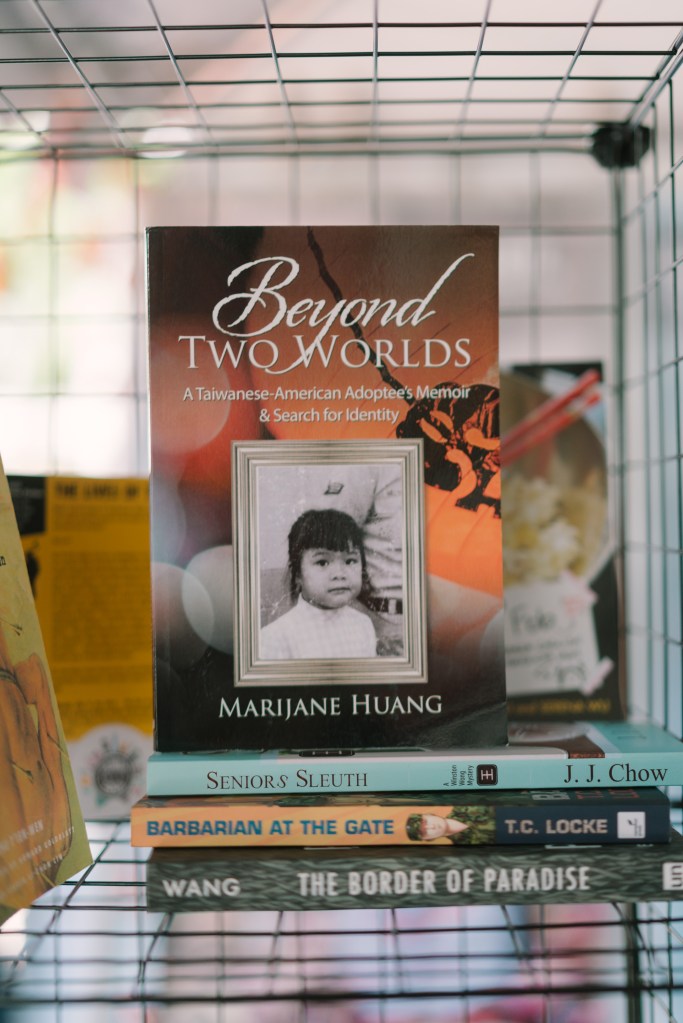


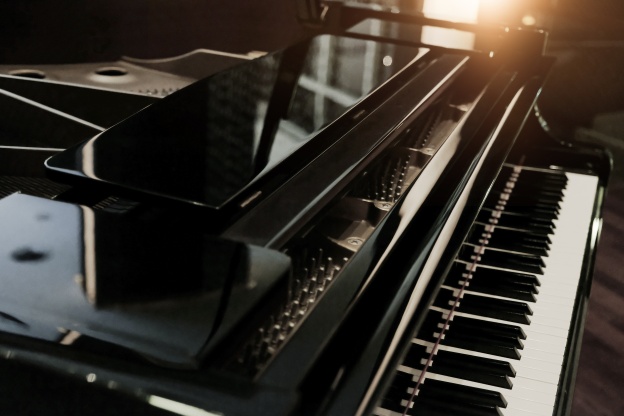



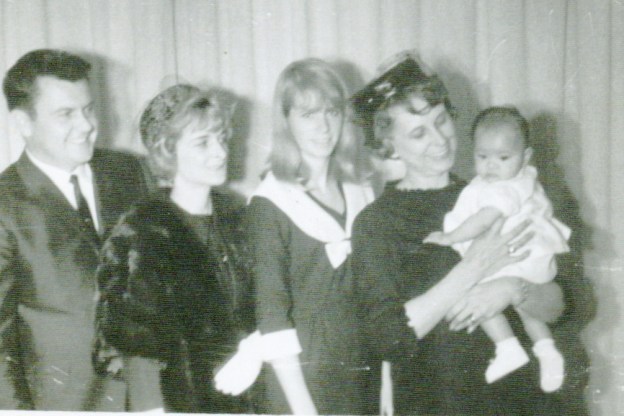


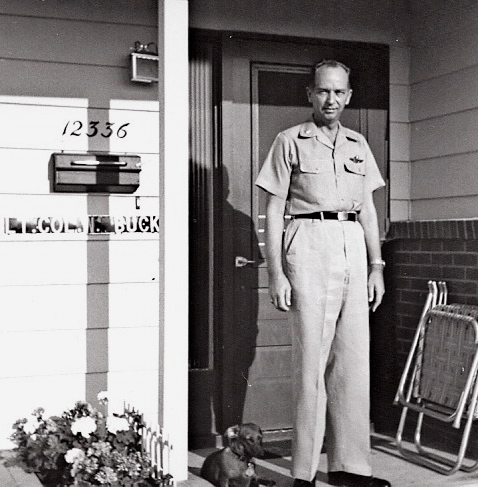 Mom married my dad on October 6, 1962, in Omaha, Nebraska where dad was stationed at Offut Air Force Base. On February 25, 1963, just four short months after their wedding, my dad suffered a subarachnoid brain hemorrhage which nearly took his life. Mom accompanied dad via air evacuation on a T-29 military aircraft to San Antonio, Texas, I’m assuming to a more specialized military hospital, where he underwent surgery. I can only imagine how frantic she must have been. In the bottom of my dad’s dresser drawer, I found an original Western Union telegram that was wired to his mother in California from Offutt AFB. This is what it said:
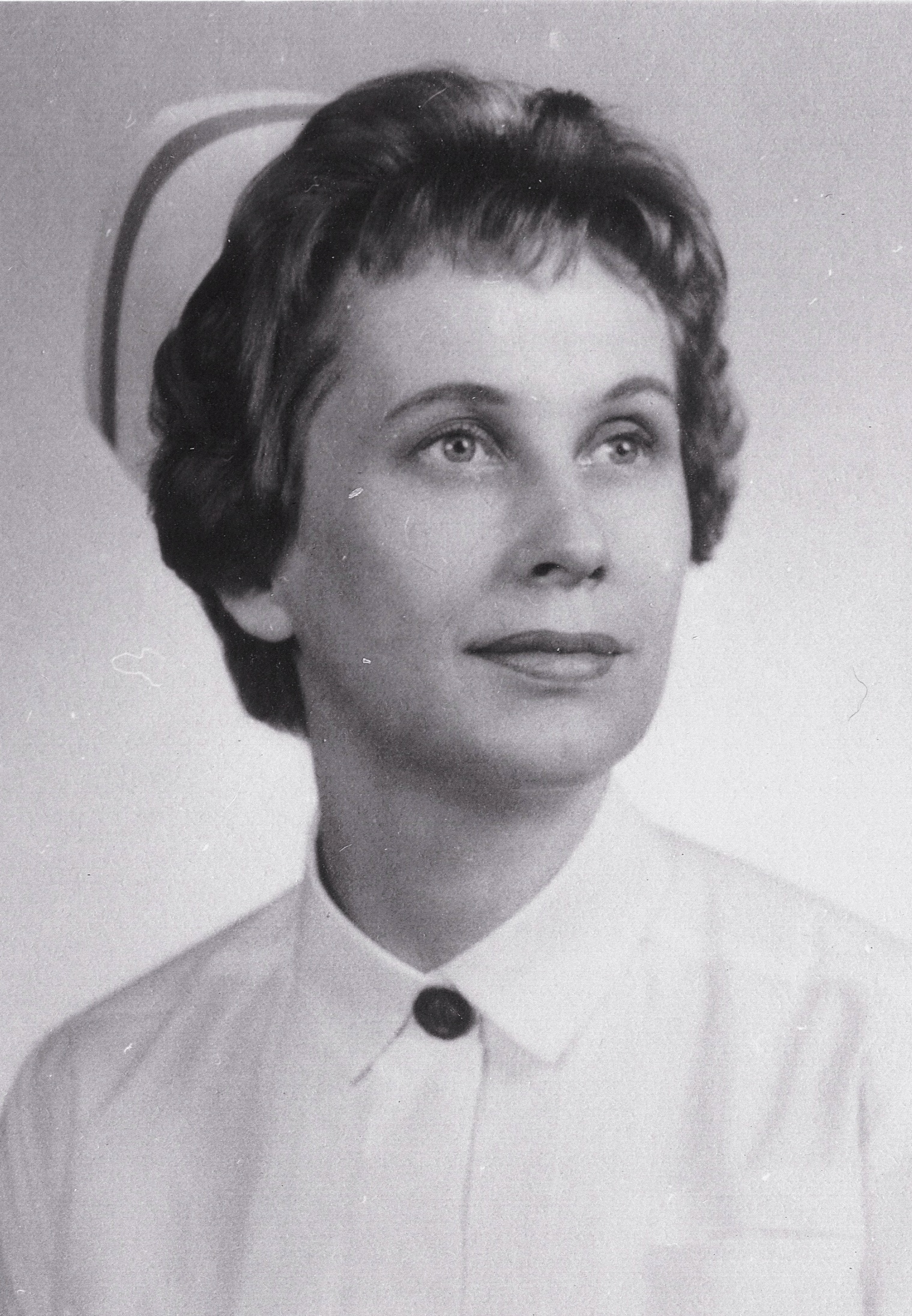 For the next two years, mom struggled through nursing school and late nights studying while juggling a demanding job and taking care of the family. I don’t know how she did it. The funny thing is, I don’t ever recall seeing her study, but according to her diaries, she often studied for biology, anatomy, chemistry and psychology after my niece and I were in bed. She spoke of the biology labs nearly killing her and failing a few tests. She was so disappointed in herself when she failed a test. She finally graduated from Northwestern University in August 1974. I will always remember mom wearing her white nursing uniform, white stockings and shoes, and nursing cap.
 The letter was left undated and appeared to be a draft from all of the crossed out words. Apparently, Mom had written the letter as a followup to a conversation she’d previously had with Dr. Woo. After reading through the first paragraph, I soon realized that this letter described my parents’ initial visit to the Family Planning Association of China, the orphanage where I was adopted. I could not read the rest of the letter fast enough. This is what it said: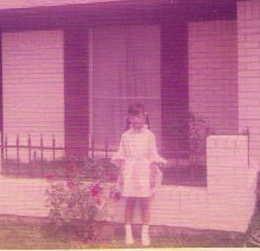

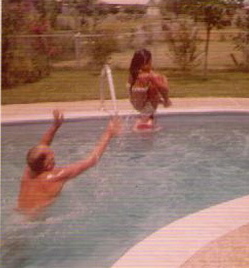


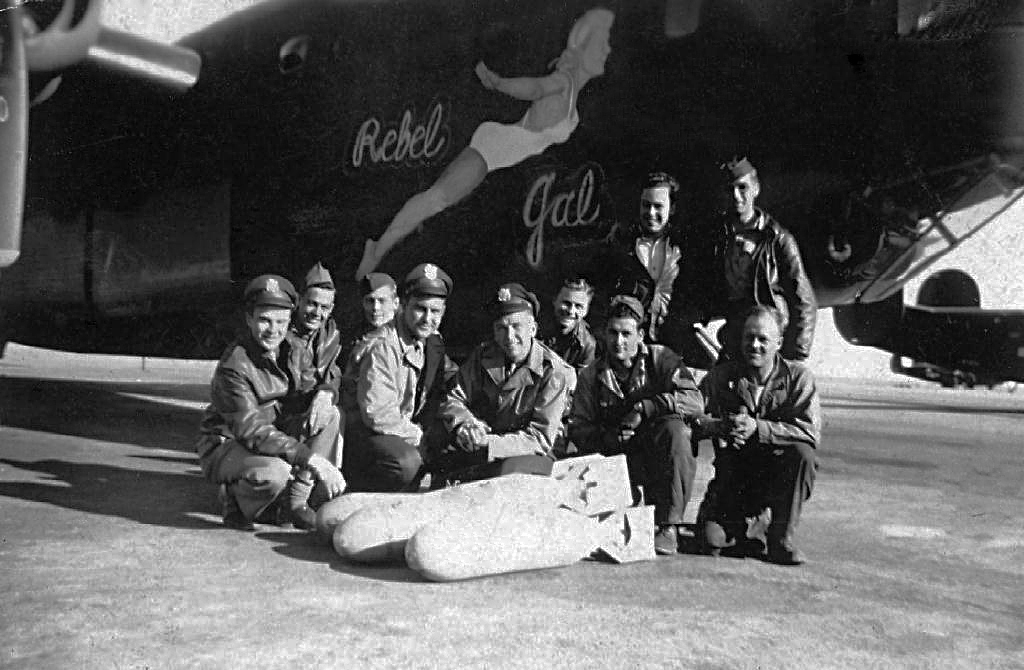

 Musings of a Taiwanese American Adoptee